how to weaponize digital footprint
a bull case for performativity

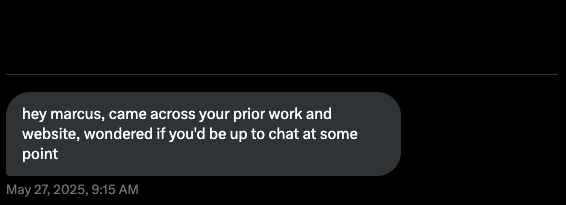
I was recently cold-DM’d on X by an investing partner of a top crypto fund. Simultaneously, he messaged Allium’s CEO (a.k.a. my boss at the time) to commend him on the great decision he had made in hiring me. This was fairly unexpected for two reasons.
First, I have no personal connection to this fund. While they do happen to be a customer of Allium’s, I’d never conversed directly with anyone on the team.
Second, my signal on X was objectively weak. This might have made sense on a platform like LinkedIn – but at the time, my X account was nascent.
So, how did he find me?
digital footprint
[
{
“username”: “marcusychua”,
“summary”: “Early-career builder who left UC Berkeley in 2025 to become employee #23 and GTM lead at Allium (crypto on-chain data platform).

Writes the company’s external research threads and internal investor letters, helping Allium land marquee customers such as Visa and Phantom.

Prior experience includes data-analytics work at Salesforce, venture research at Contrary, and AI research at Berkeley.

Publishes reflective essays on his personal site and Substack (”day 76”) and hosts NY-tech meetups—signals of initiative and community-building.

Technical depth is moderate (IEOR degree and analytics background) but there is little public code.

Clear evidence of self-direction, communication skill, and shipped impact at a fast-moving Series-A-stage startup; less proof yet of deep technical execution.

Overall: Strong GTM and storytelling founder signals with some technical chops, but limited evidence (so far) of shipping complex software personally."
}
]
This is about 1/4 of the summary transcript that his AI agent autonomously created and delivered to him. It was instructed to:
Identify crypto-related X accounts.
Ingest their digital footprint.
Assess their signal based on pre-configured criteria.
Score them based on whether or not they were deserving of outreach.
And damn was it good at ingesting. It referenced individual Substack articles to determine my communication skills + propensity for first-principles thinking, referenced parts of Allium’s website to understand my execution ability + impact within a team, and even referenced my Luma profile to see if I can attract signal as well as I emit it (see Cosplaying a Connector).
It’s not just bespoke agents that diligence using your digital footprint. Sales intelligence tools like Clay, Paradigm, and Lightfield scour external data sources for signals to qualify leads and generate pipeline. New algorithmic social graphs like Biography, Sonder, and Pally emerge weekly, each scribing a virtual web of your first-, second-, and third-order connections. With proper network effects, these platforms could use your network’s signal to assess your own.
At the end of the day, a model is only as good as its data. For decades, we’ve performed SEO to enhance visibility on search engines. More recently, we’ve done the same for generative answer engines with AEO. This is a guide for how one might approach optimizing discoverability for themselves.
caveat: digital panopticon
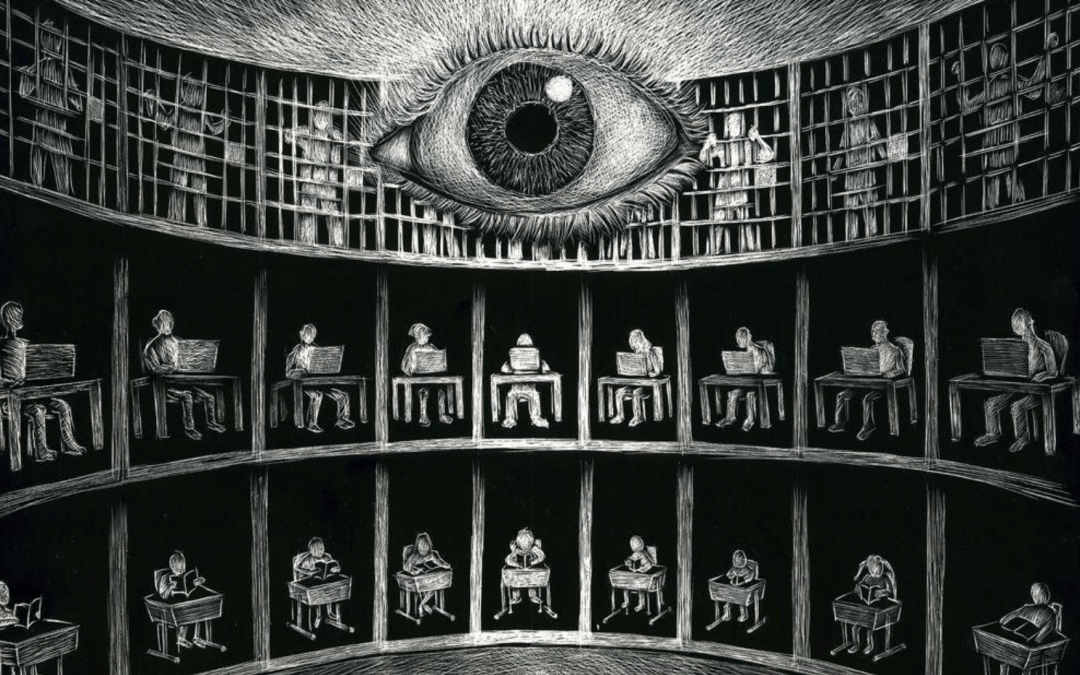
“The panopticon is a design of institutional building with an inbuilt system of control, originated by the English philosopher and social theorist Jeremy Bentham in the 18th century. The concept is to allow all prisoners of an institution to be observed by a single prison officer, without the inmates knowing whether or not they are being watched.”
French philosopher Michel Foucault famously adapted the idea of the Panopticon into a metaphor for how modern societies govern behavior. Subject to the possibility of constant observation from their social networks, people monitor and regulate themselves – whether or not anyone is actually watching. The quiet suspicion of being watched becomes a low, persistent hum that perpetuates as individuals internalize the gaze of this figurative authority.
On LinkedIn, for example, users are acutely aware that every interaction is public. Every like, comment, and connection is recorded in a public ledger of professional identity. Consequently, many hesitate to engage or post publicly, opting instead to lurk in the shadows. This is the modern echo of Foucault’s insight: we curate and constrain ourselves, not just for ourselves, but for a fabricated audience we sense, but cannot see.
So often, we silence ourselves out of fear of judgment. We swallow opinions until we’re certain they’re bulletproof. Questions cannot be asked without anonymity unless they satisfy a baseline criterion of “not stupid enough to exit my mouth”. So, we lurk. We celebrate ideas by saving them in private collections, rather than amplifying them publicly. And when someone else, peer or stranger, reaps the compounding rewards of converting an audience, all we can do is watch wistfully.
Now, for the perspective of the enterprising. The perspective of those who realize life is entirely a function of one’s audacity. We’ve established that we are being surveilled by a panoptic gaze, yes. So if they’re going to watch anyway, why not put on a show?
objective function
“If you add industrial engineering logic to the above philosophy, you derive the following: You can be anything, but not everything. All (feasible) optimization problems contain variables that can be augmented or diminished, resulting in a prime medley of these elements that resultantly optimizes an objective output.”
– Me, a look in the mirror
It’s all well and good to optimize for discoverability, but in what context? What do we want our internet friends to learn about us?
First, a personal case study. Here are two pieces of content I’ve made:
YouTube video of a song I chopped up. ~400,000 views + 8,000 likes.
Substack article about why generalists are lethal in tech. ~1000 views, 3 likes.
btw, i’ve since renounced this philosophy. the “smart generalist” is an overrated trope pushed by those lacking the will to commit // force-fed to directionless youths overwhelmed with optionality. on the other hand, asymmetric upside belongs to those who’ve specialized to the point of being top 1% in their skill(s)/domain(s).
Yes, there are many confounding variables here (age of content, platform, content type, etc). But let’s compare the materialized returns of these two pieces. Guess which piece gets flagged by AI? Which one draws DMs from headhunters / prospects?
When optimizing for conversions, engagement becomes a vanity metric. Sure, high-engagement content has a greater probability of making it onto my feed and yours as a byproduct of its delivered value (comedic, informational, or otherwise). But as feeds become increasingly tailored and our algorithms get better, there will no longer be a need to churn out slop, a need for flashy hooks and engagementbait tactics to extract that incremental second of users’ attention. Virality may get you recognized on the street, but driving conversions is purely a result of the value you bring and the philosophy you stand for.
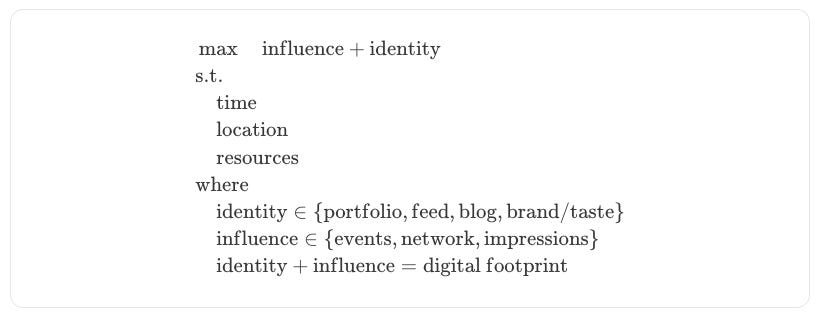
In quality and quantity alike, there are two key outputs we can focus on maximizing: identity and influence. This framework is intended to be collectively exhaustive rather than mutually exclusive – in fact, these buckets are mutualistic. Building a high-signal identity lends greater ethos with which to influence, and likewise, expanding influence creates entropy to amplify and sharpen identity.
watch your step

Tactically, building a digital footprint requires watching your step. Here’s a few landmines to avoid as you make your unique impression on the soil of the internet.
Slop: The proliferation of AI, and consequently content-generating tooling, has resulted in our feeds becoming infested with low-IQ, degenerative slop. Please do not use this piece as an invitation to spew thoughtless nonsense across your feed. Remember, the goal is to emit signal in a sea of noise.
Inauthenticity: There’s a fine line between strategic self-presentation and losing yourself in the performance. Remember who you are performing for, and why you’re performing at all. How far are you willing to go? What if the act becomes your identity? Consider who you’re signaling to, and whether their approval is worth the erosion of self.
Sacredness: While there is value in sharing yourself with the world, I caution against becoming an exhibition. The moment you design experiences for display rather than depth – sunsets watched only long enough to be posted, meals photographed until they’ve gone cold – your life is no longer yours, but the audience’s. Keep some things private, not out of secrecy, but out of reverence. The moments you choose not to broadcast often matter most.
closing braindump
“The most valuable real estate in the world is the graveyard. There lie millions of half-written books, ideas never launched, and talents never developed. Most people die with everything still inside of them.
The way to live is to create. Die empty. Get every idea out of your head and into reality.
Calling yourself creative doesn’t make it true. All that matters is what you’ve launched. Make finishing your top priority.”
– Derek Sivers, How to Live: 27 conflicting answers and one weird conclusion
As the singularity nears, we are faced with a choice: to create or to consume. Building anything – products, content, presence – is the highest-leverage activity available to you. You manifest an infinitely scalable asset with uncapped potential to attract, convert, and compound. An extension of you that delivers value to the world while you sleep.
The panopticon is real. The machines now know more about you than you might know yourself. But if they’re watching anyway, why not leverage that gaze? Let the algorithm work for you. Not by performing for it, but by creating so prolifically, so authentically, that your signal becomes unmissable.
This piece is an ode to the half-finished passion projects. The cinematography captured but never edited or distributed. The essays trapped in drafts. The ideas rotting in your notes app. The unshipped code. The ideas that die when you do.
For those who were here since day one, my original description for this newsletter was “writing to save my thoughts from my overheating mess of a mind.” If you’re still reading this, I suspect yours might need saving too. Get them out of your head and into the world.
good
pov: generalist in tears